
Career Options After Class 10 in India
Class 10 is the first point where most students choose a direction. This guide explains the main routes in India: the Science, Commerce and Arts/Humanities streams in Classes 11–12, and job-oriented diploma and ITI courses, so you can compare them before you decide.
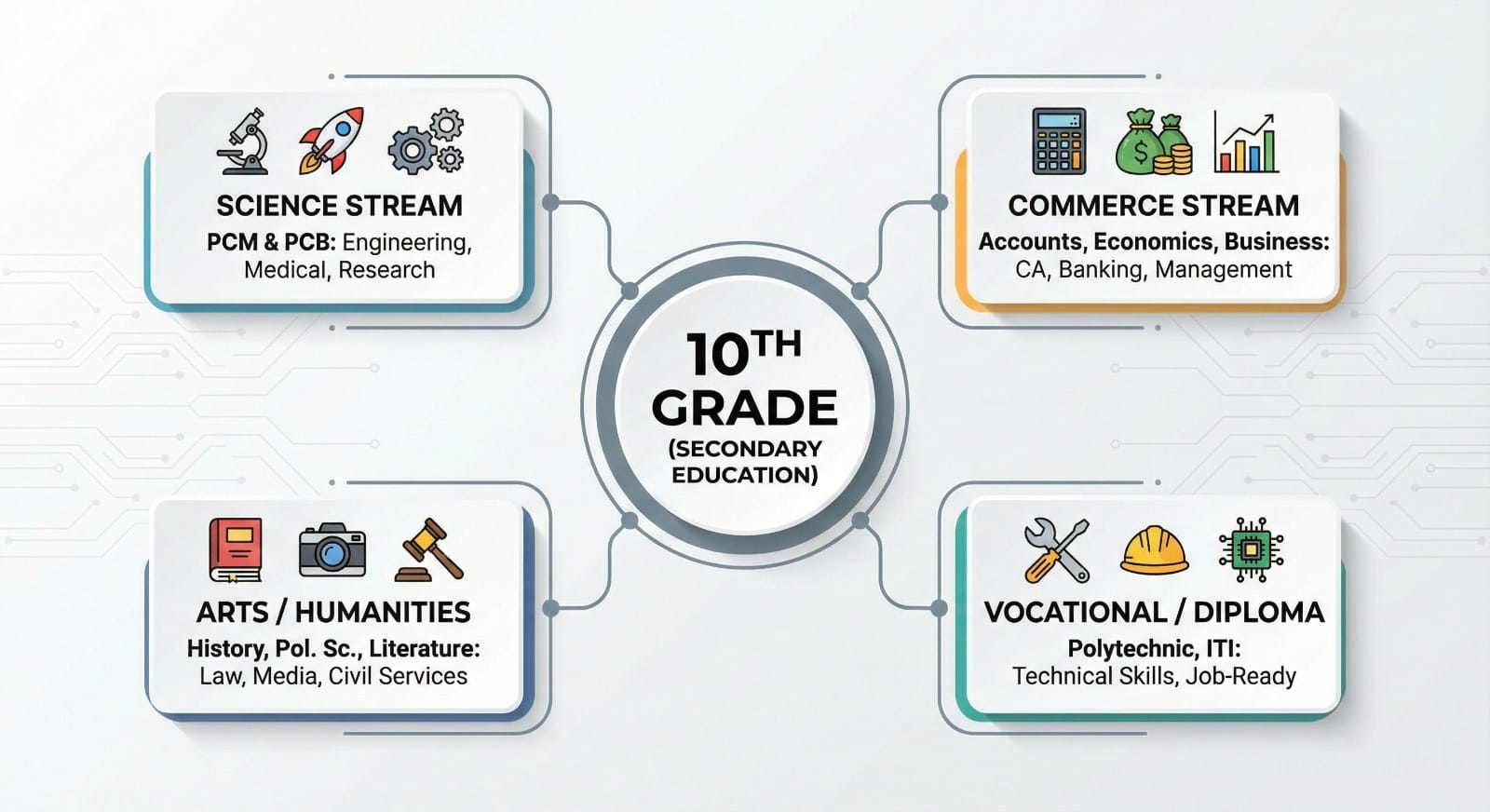
Your main options at a glance
| Pathway | What it involves | Common next steps |
|---|---|---|
| Science | Classes 11–12 with Physics and Chemistry plus Mathematics (PCM), Biology (PCB) or both (PCMB) | Engineering, medical and allied health courses, pure sciences, computing and data, pharmacy, agriculture |
| Commerce | Classes 11–12 with subjects such as Accountancy, Business Studies and Economics; Mathematics is optional in many schools | B.Com, BBA, economics, and professional courses such as CA, CS and CMA |
| Arts / Humanities | Classes 11–12 with subjects such as History, Political Science, Geography, Sociology, Psychology, Economics and languages, depending on the school | BA programmes, law, journalism and media, design, teaching, psychology and social sciences |
| Diploma (polytechnic) | A technical diploma, usually three years, in fields such as engineering | Entry-level technical jobs, or further study; in many states diploma holders can join a B.Tech course in the second year (lateral entry) |
| ITI | Trade-based vocational training, with duration and eligibility depending on the trade | Skilled-trade jobs, apprenticeships and further training |
Subject choices, eligibility and admission rules depend on your board, school and state, and they change over time. Confirm the details with your school and with the official websites of the board or institution before you decide.
The pathways in more detail
Science stream
Typical subjects: Physics, Chemistry and either Mathematics (PCM), Biology (PCB) or both (PCMB), along with languages.
Possible next steps: Engineering and technology programmes generally expect Mathematics in Class 12, and medical and many health-science programmes generally expect Biology. Many of these courses admit through entrance exams, so check the current eligibility rules for the course you are considering. Science also leads to B.Sc degrees, computing and data courses, pharmacy and agriculture.
Who may consider it: Students who enjoy problem-solving, experiments or understanding how things work, and who are ready for a demanding subject load. Choosing PCMB keeps both paths open, but it means a heavier workload.
Commerce stream
Typical subjects: Accountancy, Business Studies and Economics, with Mathematics or another optional subject where the school offers it.
Possible next steps: B.Com, BBA and economics degrees, and professional courses such as Chartered Accountancy (CA), Company Secretary (CS) and Cost and Management Accountancy (CMA), each with its own registration and exam process.
Who may consider it: Students interested in business, money, markets, accounting or management, and comfortable working with numbers.
Arts / Humanities stream
Typical subjects: A mix of subjects such as History, Political Science, Geography, Sociology, Psychology, Economics and languages. The exact choices depend on the school and board.
Possible next steps: BA programmes, law (many integrated law programmes admit after Class 12 through entrance tests), journalism and media, design, teaching, languages, psychology and social sciences. Competitive exams such as the UPSC Civil Services require a bachelor’s degree in any discipline, so Arts is one route among several, not a requirement.
Who may consider it: Students interested in society, language, history, politics, law, media or creative work.
Diploma and polytechnic courses
Typical training: Usually a three-year, practice-oriented technical course in an engineering or similar field, taken after Class 10.
Possible next steps: Entry-level technical roles, or further study. In many states a diploma holder can enter the second year of a B.Tech programme through lateral entry, subject to state rules and eligibility.
Who may consider it: Students who prefer hands-on technical learning, or who want to build job-ready skills earlier. Check that the institute and course are recognised or approved before you apply.
ITI courses
Typical training: Trade-based vocational training, for example in trades such as electrician, fitter or computer operator. Duration and eligibility depend on the trade.
Possible next steps: Skilled-trade employment, apprenticeships, self-employment or further training. Some states offer routes from ITI into diploma courses; rules vary by state.
Who may consider it: Students who want a practical trade skill quickly and are comfortable with workshop-based learning.
How to choose between them
No stream is better for everyone. Each one leads to many careers, and the right choice depends on you. These factors matter most:
- Interests: What subjects or activities do you keep returning to without being told to?
- Strengths: Which subjects do you understand more easily, and where do you need to work harder?
- Eligibility and availability: Which subject combinations does your school or nearby schools offer, and which entrance exams or marks might you need later?
- Finances: What will the course, travel and living costs be, and are scholarships or government institutions an option?
- Future goals: Which careers appeal to you today, and how easy is it to change direction later?
A simple way to decide
- Write down two or three directions that interest you.
- For each one, find out which subjects and exams it usually requires.
- Talk to teachers, family members or people already working in those fields.
- Compare costs, locations and the recognition of the institutions you are considering.
- Keep a fallback option so one result does not close every door.
Mistakes to avoid
- Choosing a stream only because friends or relatives did.
- Assuming one stream is automatically “the best” for everyone.
- Ignoring eligibility rules and entrance exams until Class 12.
- Joining a course without checking that the institute is recognised.

Related guides
- How to Choose Your Career: match your interests and skills to career options.
- Government vs Private Jobs: compare the two paths before you decide where to aim.
- Technology and data careers, Finance and business careers and Digital and creative careers.
- Digital Marketing Career in India for Freshers: an example of a skills-based career path.
- All Career Options guides
This guide gives general information about common pathways in India. It is not personal counselling or admissions advice.
Have a question about this guide?
Send us your details and your question using the form below.